
Stars in our Sky: Two Wet Dogs Maple syrup turns passion, heritage and nature into award-winning success
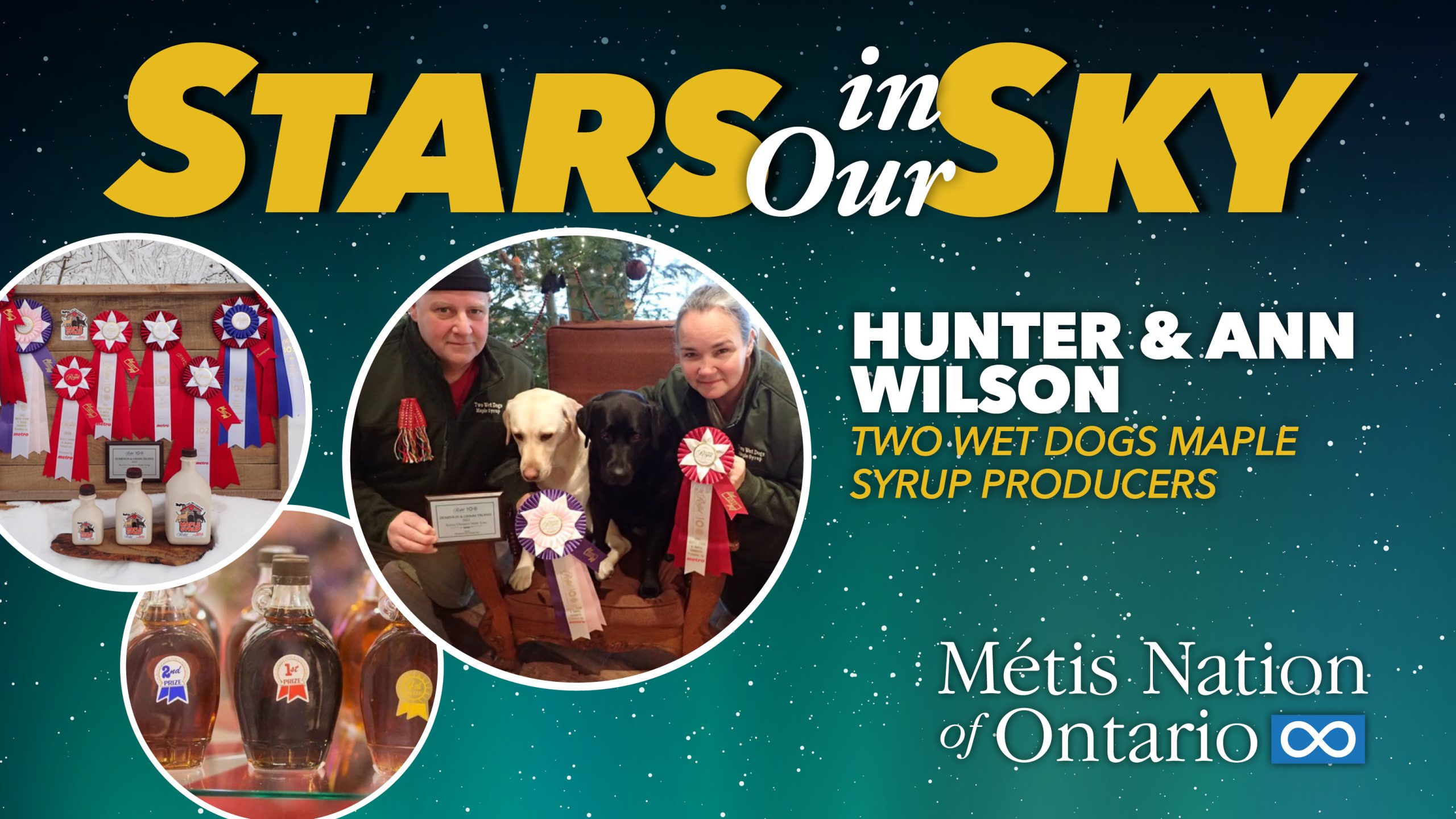
For Hunter and Ann, maple syrup is more than a product—it’s a way of life.
Nestled in the forests in Loring, Ontario, the husband-and-wife team behind Two Wet Dogs Maple Syrup have built an award-winning business rooted in a love of nature, community, and Métis heritage. What began as a social pastime among neighbours has grown into a respected maple syrup operation producing hundreds of litres of syrup each year, earning championship titles and loyal customers across Canada.
“We moved up here in 2011,” Hunter recalled. “There was a neighbourhood sugar shack where people would gather, boil sap, tell stories, and spend time together. I have such good memories of maple syrup growing up, so I connected with it right away.”
While those early experiences sparked his interest, Hunter soon became determined to improve his craft. With guidance from a local, award-winning maple syrup producer, he and Ann began developing their own operation.
Today, Two Wet Dogs Maple Syrup taps approximately 1,000 trees and produces up to 900 litres of syrup in a good year. Despite their success, the business remains a small, family-run operation powered by just two people—and two enthusiastic Labrador retrievers.
The company’s unique name came about one spring day in the sugar shack.
“We have two Labs, and they’re seldom dry,” Hunter laughed. “One day they were curled up in the corner of the sugar shack after being out in the bush all day. We looked at them and thought, ‘They give us so much joy. We should call our company Two Wet Dogs.’”
The name stuck, and so did the dogs, who continue to accompany Hunter and Anne through every stage of the maple syrup season.
Hunter’s connection to the Métis Nation came later in life. He was in his thirties when he first learned about his family’s Métis ancestry through his mother’s side. Research led him to discover family connections stretching from North Dakota through Manitoba, Saskatchewan, and Northwestern Ontario.
“It was something that just wasn’t talked about when I was growing up,” he said. “My brother started uncovering information, and suddenly we were learning about relatives in North Dakota and tracing our family history. My jaw just dropped.”
Through his journey of reconnecting with his heritage, Hunter found support and belonging within the Métis community. He credits Métis Elder Elize Hartley as a particularly important influence, describing her as an adopted grandmother who helped guide his family and even participated in his wedding ceremony.
“It’s just nice belonging to a community,” he said. “The Métis community has always been welcoming.”
Growing up in the Brantford area, Hunter spent countless hours hunting, fishing, and exploring the outdoors. When he and Anne moved north, he quickly fell in love with the forests surrounding Loring and the opportunity to spend more time on the land.
“Making maple syrup is my communion with nature,” he explained. “It’s for my mental health. We’re out in the woods year-round maintaining the forest, repairing equipment, and taking care of the lines. Somehow this kind of work doesn’t feel like work—it feels like therapy.”
That connection to the land extends to the way Two Wet Dogs operates. The sugar bush is set up on a natural valley system that allows sap to travel downhill through gravity-fed tubing, reducing the need for energy-intensive equipment and lowering the operation’s environmental footprint. Rather than relying on mechanical vacuum systems, the operation uses the landscape itself to move sap from the trees to the sugar shack.
Hunter also sees maple syrup as an important part of Métis history and culture. Historically, maple sugar served as both a valuable food source and a trade commodity of Indigenous peoples. For Métis families emerging from winter, it offered a welcome source of energy and sweetness and needed carbohydrates, and it became an important staple in communities across the homeland.
One of Hunter’s proudest accomplishments is supplying maple syrup for Métis Nation of Ontario initiatives and events. Each year, Two Wet Dogs fulfills a special order for Louis Riel Day that helps share a taste of Ontario’s maple forests with fellow Métis citizens.
“My main goal every year is to make sure we fulfill our commitment to the Métis Nation of Ontario,” Hunter said. “It’s important to us that we can share it with other Métis families.”
Hunter also credits the MNO for helping the business grow. Through support from the Economic Development Consultation Committee, Two Wet Dogs was able to purchase equipment that improved efficiency, reduced emissions, and accelerated the company’s development.
“The Métis community has been incredibly supportive,” he said. “They’ve helped us achieve our goals and continue growing.”
The dedication Hunter and Ann bring to their craft has earned them significant recognition. Their syrup has received multiple awards at the Royal Agricultural Winter Fair, including world championship honours. For Ann in particular, the achievements have been especially meaningful. Having grown up attending the fair with her grandfather, who served as a judge there, seeing their syrup recognized on that stage was an emotional milestone.
Yet despite the accolades, Hunter remains focused on the simple joys that first drew him to maple syrup production.
“The smell of maple syrup, the sound of the evaporator boiling, the steam, the wood smoke—it’s the whole experience,” he said. “It’s good for your head. It helps ground me, makes me feel good, and I love it.”
He also hopes to pass on what he has learned to others.
“If somebody wants to get started in maple syrup, I’m always open to helping,” Hunter said. “That’s what happened for us. Someone took the time to mentor us, and it made all the difference.”
For Hunter and Anne, every bottle of syrup represents more than a harvest. It reflects a deep connection to the land, a commitment to quality, and a desire to share both with the communities they call home. Their story is a reminder that success often grows from simple beginnings—a love of nature, a willingness to learn, and the joy found in sharing something meaningful with others.