
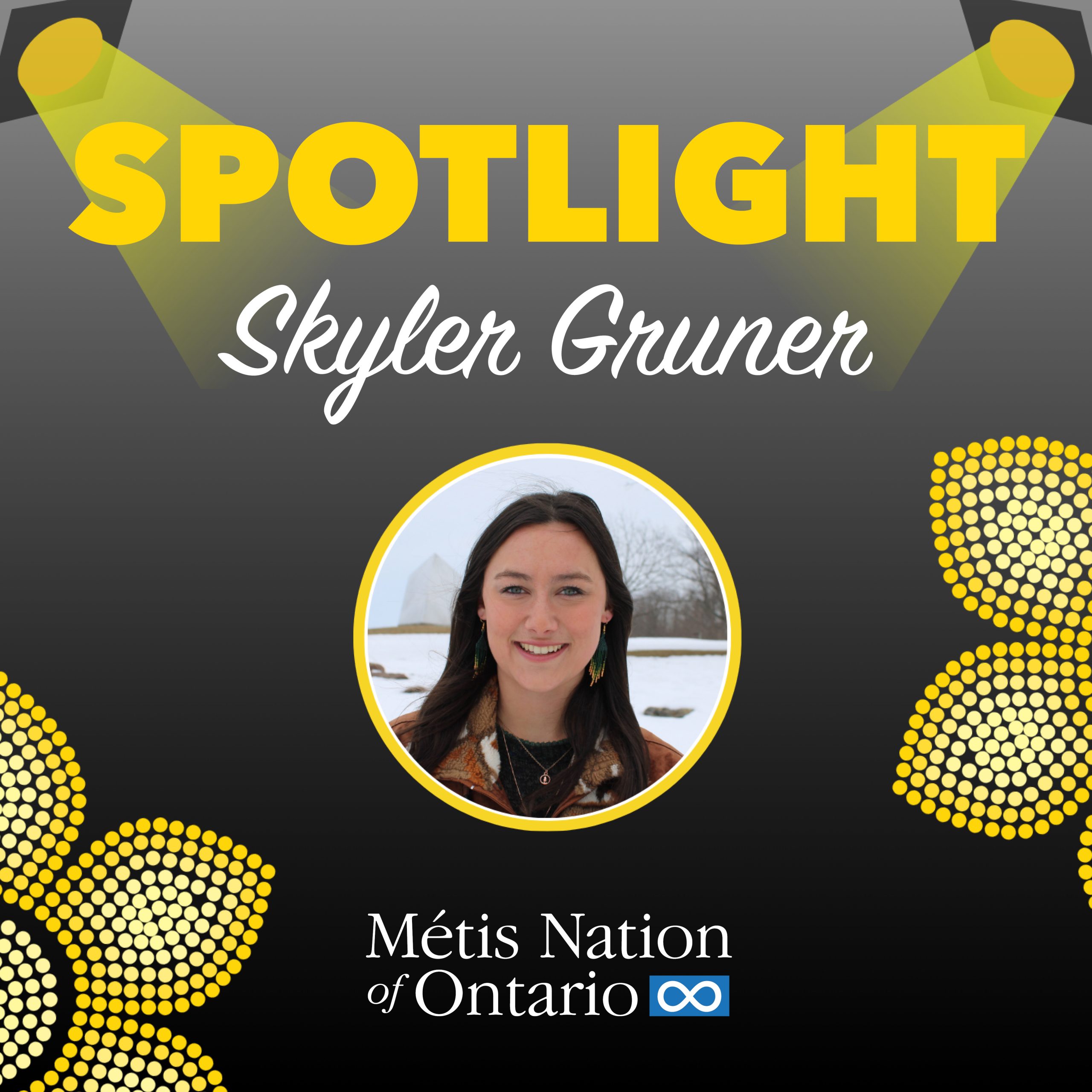
Q: Hi Skyler, tell me about yourself! What do you like to do for fun in your spare time?
A: Anything outside! I love being outside, no matter the weather or the season. I love canoeing in the spring and summer, hiking and camping, and running too. I love to ski during winter, both cross-country and downhill, and I’m always ready to take on my brothers playing shinny on the outdoor rinks.
Q: Tell me more about the importance of community in your life. How have you found community at Queen’s University?
A: To me, community is stability. Community provides a feeling that I sometimes struggle to put words to, but one that I can feel deep in my bones. Community is the force that lifts me up and propels me forward. At Queen’s, I was lucky to find community at the Four Directions Indigenous Student Centre. It all started on the first day, moving into my dorm room with the STEM Indigenous Academics program at Queen’s, which hosted a multi-day orientation for Indigenous students in STEM a week before the general student body moved in. We were able to meet each other and develop friendships right away in a small-group environment. The orientation program helped us with the challenging transition from high school to university, and allowed us to get situated. From that first introduction to Queen’s, I felt connected and grounded in a way that would not have been possible without the support from the Four Directions staff and the other Indigenous students. Since then, I have gone to many of the events hosted at Four Directions, and this past year took on the role of Social Ambassador to give back, hoping to extend the support I found in first year to other Indigenous students who might feel lost in an institution so different from home. In this role, I helped plan social events to bring Indigenous students together from across campus and strengthen our Indigenous student community. In a full-circle kind of way, this giving back allowed me to really deepen my connections and to feel even more stable at Queen’s.
Q: What inspired you to pursue the Health Sciences program at Queen’s? How did you first discover this was a field you wanted to enter?
A: As a kid, I was always drawn to anything related to the human body. I loved figuring out how things worked, why our bodies can do such complex things, and at the same time how something as small as a virus could disrupt those systems in really serious ways. That curiosity has stuck with me. I came to realize early on that I learn best when I can actually apply what I’m learning, not just memorize information and regurgitate it in an exam. I’ve always preferred hands-on learning opportunities, things like labs or problem-solving activities, and one of the biggest factors that made me choose Queen’s Health Sciences was the first year required anatomy lab. And it did not disappoint! That anatomy lab was one of my favourite classes ever. What really drew me to the Health Sciences program at Queen’s was the structure; it’s centered on group-based learning where you’re working collaboratively on projects and applying concepts from the modules that you completed earlier in the week. That combination of teamwork and learning about topics that I found so fascinating felt like a natural fit.
Q: Why is science so important in 2026?
A: This is such an interesting question, because absolutely, science is needed for everything. I really think that it makes up the basis of our world and we wouldn’t be where we are today as a society without it. Science helps answer those burning questions about life, those big, fundamental questions about how things work, why things happen, and how we can solve complex problems. At the same time, science as it’s known in Western contexts can sometimes be pretty narrow in how it defines knowledge. I think it’s really important to recognize that the broad umbrella for science captures more than just quantitative metrics and numerical reconstructions of life on Earth. Especially with AI emerging and rapidly reshaping so many fields, I think science is becoming even more important, but not just in the traditional sense of the word. It’s not only about advancing knowledge or technology, it’s about broadening what we consider to be knowledge in the first place. There’s a real need to bring in diverse perspectives and ways of understanding so that science is more inclusive, more thoughtful, and ultimately more representative of our populations.
Q: You have been advocating for waiving membership fees for Indigenous students in the Outdoors Club at Queen’s University. Can you speak more about these efforts and why they’re important?
A: There are so many Indigenous advocates working to get their land back and fighting for land-rights. It surprises me that something so simple as a university Outdoors Club still made Indigenous students pay the same membership fees as all other students, when the lands we were accessing for these student-led trips were the traditional territories of so many of the students here. It was really just one more barrier in a system that wasn’t designed for us. Alongside my club co-executives, we brought up the idea to waive fees for Indigenous students interested in joining the Outdoors Club. We were surprised to encounter initial rejection from staff in positions of power. Their hesitation was rooted in concern about appearing “performative” or engaging in “identity policing.” To me, this reflected a broader barrier: many settlers want to act in support of decolonization but fear of doing so incorrectly results in no action at all. This illustrates the paralysis that arises when good intentions are not paired with sufficient awareness, understanding, trust, and meaningful dialogue. Dismantling such barriers begins with education, relationship-building, and creating spaces where questions can be asked openly. That’s why these land-based efforts are so important; they highlight where change needs to be made and where the root of problems like these often lie.
Q: You’re currently an MNO Infinite Reach Facilitator. How did you first learn about the Infinite Reach Student Solidarity Network, and what made you be a part of it?
A: I first heard about the Infinite Reach Student Solidarity Network during my second year at Queen’s, when Kelsey Piché, an Education and Partnership Advisor with the MNO, came to Queen’s for an outreach event. I remember being pretty nervous to go because I wasn’t totally sure what to expect, but I pushed myself to show up and ask a few questions about how I could get involved with the MNO in more of a leadership capacity. In that conversation, Kelsey told me about the Infinite Reach Facilitator network, and it immediately clicked for me. Outside of school, I love beading, it’s something I really value both creatively and culturally, and hearing that there was a program where I’d be supported in organizing beading events and other Métis-specific programming for students felt like such a natural fit. It was about creating space and community in a way that felt meaningful to me.
Q: What are the benefits of Infinite Reach for post-secondary Métis students? What is unique about what it offers students? How has it helped you?
A: I think the biggest benefit of Infinite Reach for post-secondary Métis students is that it really creates intentional space for Métis students to come together. A lot of the time, it can feel like Métis students are pushed to the side or kind of folded into broader Indigenous categories where the distinctions between First Nations, Inuit, and Métis experiences aren’t always fully recognized. Having something that is specifically Métis-focused makes a huge difference. What’s really unique about Infinite Reach is that it allows us to build that Métis-specific community within our own institutions, but also to extend beyond the confines of our own campuses. It creates opportunities to engage with other Métis students across different universities in Ontario, which makes the community feel a lot bigger and more connected. For me personally, it’s been really meaningful in terms of both community and leadership. It’s given me the space and support to create programming that actually reflects who I am and what I care about, while also connecting with other Métis students who I might not have otherwise met.
Q: What are you most proud of in your time as an Infinite Reach Facilitator?
A: I think what I’m most proud of is the Métis community we’ve been able to build at Queen’s through these Infinite Reach events. It’s been really meaningful to see students come out to the Métis-specific programming, especially some who don’t usually spend time at Four Directions (our Indigenous Student Centre). That, to me, felt like a really important shift. There can be a lot of uncertainty for Métis students, especially when wanting to access the programming at Four Directions. There’s a lot of hesitancy that stems from questions about identity and feelings of not being “Indigenous enough”. That can make it really hard to show up in those spaces and a lot of Métis students just don’t end up coming at all. I think the best part was really just watching that confidence grow and seeing new Métis faces at Four Directions.
Q: How has your Métis background had an impact on your life and how you think of yourself?
A: My Métis background has really shaped my sense of community and connection. Human beings are social creatures, and there’s a reason why cultures developed in the first place and why it can be so horribly destructive when that culture is erased. Growing up as an urban Métis person sometimes made me feel pretty alone and unsure of where I fit in. But over time, I’ve come to understand that being Métis comes with challenges and a lot of strength. Learning that it’s okay to embrace my heritage and be proud of it has been really grounding for me. It’s allowed me to start imagining a future where I can merge my Métis heritage and my goals of working in healthcare without feeling like I have to separate those parts of myself. My background has given me a sense of community and support, but also a real drive to create change. I think that drive is a big part of how I understand myself now; it’s tied to my values, what I care about, and how I want to move through the world. Being confident in who I am, even in spaces that weren’t really designed for worldviews like ours, has helped me better understand what motivates me and where I see myself going in the future.
Q: What advice would you offer to a younger version of yourself or students currently battling through adversity?
A: I think the biggest piece of advice I’d give is to stay confident in who you are. When you’re battling through adversity, it’s really easy to start doubting yourself, but it’s so important to hold onto your strengths and recognize that you have something valuable to bring to the table. I’d also say don’t be afraid to lean on your community, your loved ones, friends, and family. You don’t have to do everything on your own, and asking for help isn’t a weakness. At the end of each day, when you look up at the stars, remember your ancestors and the work that they put in so you could be in the spaces you’re in today. When things feel overwhelming, remember them and what they lived for. So really, it comes down to embracing who you are, trusting your strengths, and returning to community whenever you need support.