
Jim Logan’s art tells the stories communities shouldn’t forget
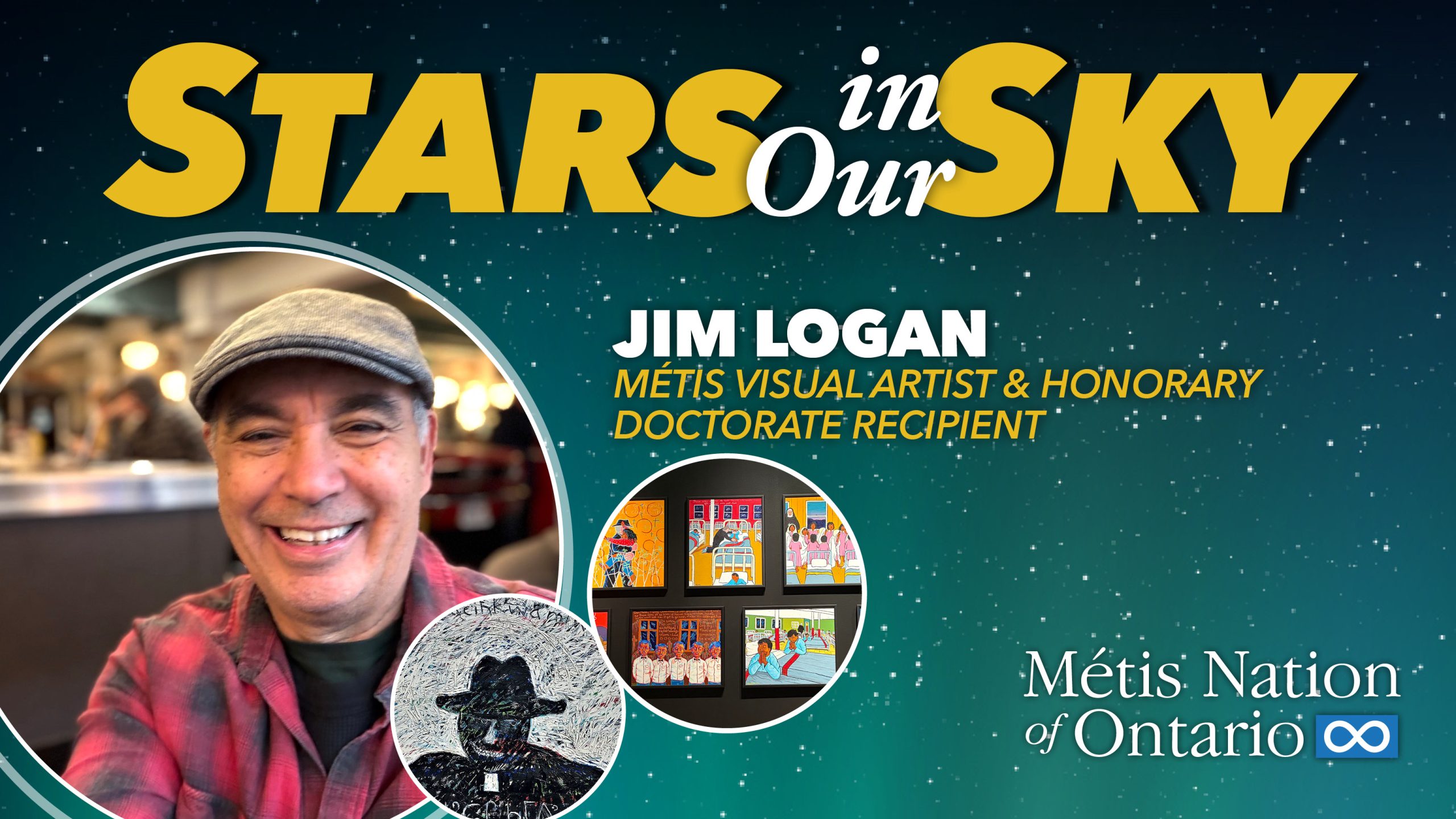
For more than 40 years, Métis artist Jim Logan has used paint to preserve stories that too often went untold.
Now based in Ottawa, Logan was recently the subject of Requiems: Jim Logan, a major retrospective exhibition at SAW featuring more than 60 works spanning four decades. The exhibition, which ran from May 1 to August 15, 2026, offered a rare opportunity to see the evolution of an artist whose work has helped bring Métis and Indigenous stories, communities, and histories into view.
From vibrant community scenes to powerful works confronting residential schools, racism, and discrimination, Logan’s career has been shaped by the guiding belief that art can bear witness.
“I’ve always been painting,” Logan said. “Even when I was working full-time, I always kept creating.”
Born and raised in British Columbia, Logan’s Métis roots trace back to the Red River Settlement and St. Norbert Parish. His family later settled in Alberta, where generations maintained strong connections to Métis culture and community. Although he grew up far from those historic homelands, his identity remained a constant influence throughout his life and work.
Originally trained as a graphic designer, Logan moved to Whitehorse in the early 1980s to work for an Indigenous publishing house. It was there that his understanding of Indigenous realities deepened.
While volunteering in an Indigenous community, Logan encountered living conditions that left a lasting impression. Families lacked running water, Elders struggled with food insecurity, and the effects of residential schools were still painfully evident in everyday life.
“I couldn’t believe people didn’t know what was going on,” he recalled.
Unable to shake what he had witnessed, Logan turned to art.
His early pastel paintings documented scenes from northern Indigenous communities, not to sensationalize hardship, but to acknowledge it while celebrating the resilience of the people who called those places home.
Many of those same themes continue throughout his work today.
“I never wanted to paint just landscapes,” Logan explained. “It’s about the communities.”
His paintings are immediately recognizable for their bold colours and strong black outlines, influenced by celebrated Indigenous artists such as Daphne Odjig and Jackson Beardy. Although the settings are often inspired by real communities, Logan intentionally avoids depicting any single location, instead creating spaces that reflect shared Indigenous experiences across the country.
Over the years, his work has expanded to tackle difficult chapters of Canadian history.
His Requiem for Our Children series explored the trauma of residential schools long before the subject entered the national conversation. In a more recent series, Logan examines the discrimination Indigenous veterans and families faced when they were refused service in restaurants, bars, and legions, despite having served their country. The paintings honour the establishments that welcomed Indigenous patrons while preserving a history many Canadians have never heard.
Beyond his own studio practice, Logan has helped shape opportunities for countless Indigenous artists.
After relocating to Ottawa, he became the Canada Council for the Arts’ first Indigenous Visual Arts Officer, where he spent nearly 16 years supporting Indigenous artists and helping establish funding and programs dedicated to traditional Indigenous arts. Throughout that time, he continued painting, balancing public service with his own creative practice.
Now long into his career, Logan’s retrospective brings together works collected from across Canada, offering visitors a rare opportunity to see the evolution of an artist whose career has mirrored the growing recognition of Indigenous voices in Canadian art.
For emerging Métis artists, his advice is simple.
Study the work of others. Stay true to your own vision. And don’t be discouraged by the challenges.
“It’s not an easy thing to make a career out of,” Logan said. “But be honest with your work.”