
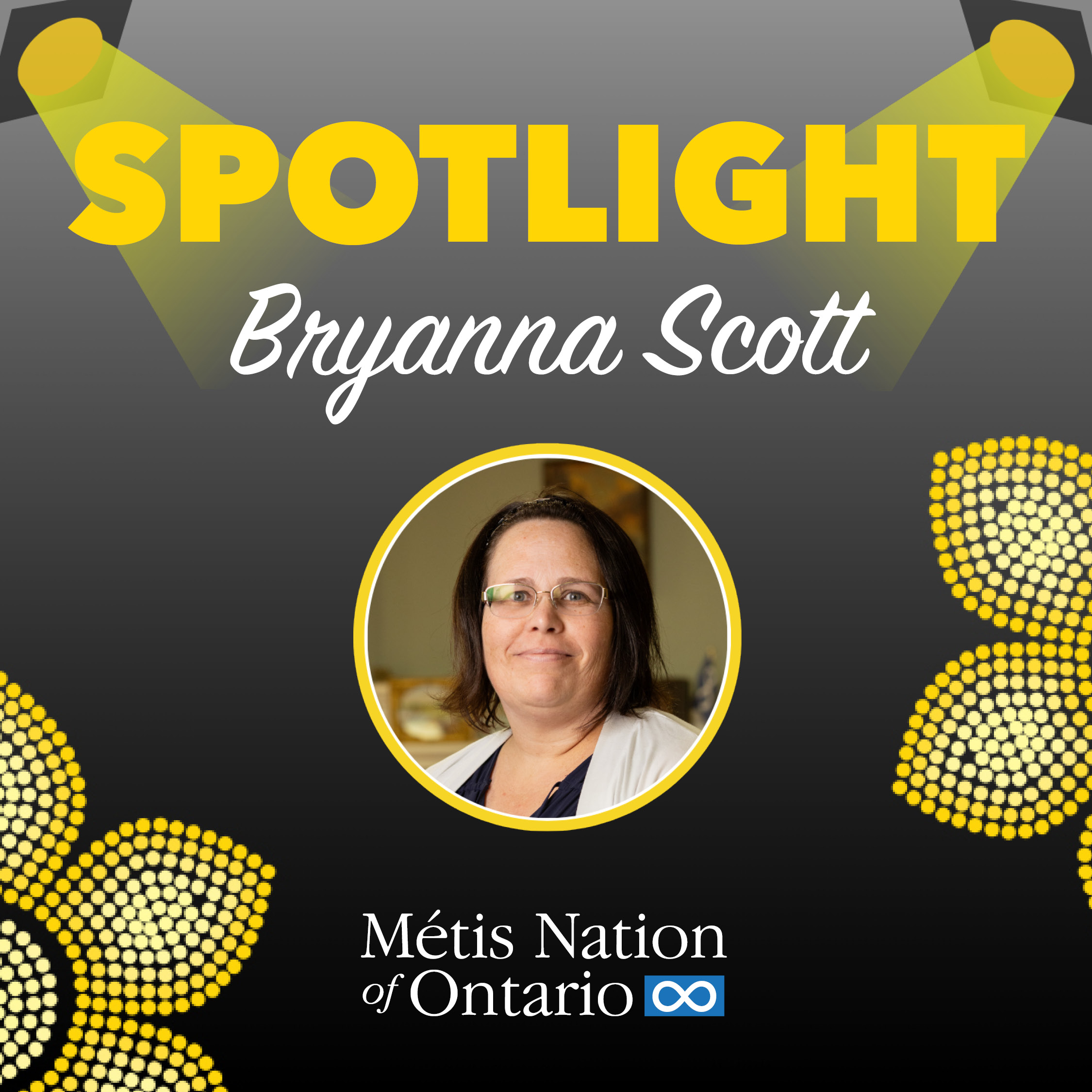
Q: You were born and raised in Fort Frances and have lived in Thunder Bay since you began post-secondary. How have these environments shaped you as a Métis individual?
A: Growing up in Fort Frances shaped my understanding of Métis identity in a very grounded, relational way. It is a place where family, community, and land are deeply connected, and those relationships taught me early on what it means to belong to a Métis Nation. The rivers, the stories, and the people in Treaty 3 shaped my sense of responsibility and pride.
Moving to Thunder Bay for post‑secondary expanded that perspective. It gave me opportunities to learn, teach, and work alongside Indigenous students and educators from many Nations. Thunder Bay challenged me, supported me, and helped me grow into the person and leader I am today. Both places — one rooted in home, one rooted in growth — have shaped how I carry myself as a Métis woman and how I approach community‑driven education.
Q: The Education & Training Branch is currently celebrating its 30th Anniversary, having been established in 1996. What does it mean to you to play such a significant role in the branch’s history?
A: It is incredibly meaningful. The Education & Training Branch has spent three decades supporting Métis learners, families, and educators, often in ways that quietly but powerfully shaped opportunities across the province. To be part of this milestone — and to help guide the Branch into its next chapter — is both an honour and a responsibility.
I think often about the people who built this Branch: the early advocates, the community leaders, the staff who worked tirelessly to create programs long before distinctions‑based policy existed. Their commitment laid the foundation for everything we can do today.
Being in this role during the 30th Anniversary means carrying that legacy forward while also helping shape what Métis education will look like for the next generation. It means strengthening governance, expanding supports, advancing Métis‑specific policy reform, ensuring Ontario curricula reflect Métis history, language, and rights, and helping our learners see themselves reflected in every part of the education system.
Q: What are you most proud of in your time as the Education & Training Branch Director thus far?
A: I am most proud of the way our Branch has strengthened distinctions‑based Métis education across Ontario. We have expanded early learning and child care programming, advanced Métis‑specific education policy, supported post‑secondary learners, and built stronger relationships with communities in employment and training. We have also brought culture and way‑of‑life teachings to younger generations while focusing on reclaiming and revitalizing our language — work that reflects who we are as a Nation and what we want for future generations.
Cultural and language initiatives are an important part of that work. Métis education has always extended beyond classrooms, and efforts to revitalize Michif, support land-based learning and bring Métis culture into educational settings help ensure that future generations have opportunities to learn about their history and culture.
I am also proud of the team — their commitment, creativity, and care. Together, we have created programs that reflect Métis values, supported learners through major transitions, and helped build a clearer, more confident identity for Métis education in the province. Seeing Métis students, families, and educators feel seen and supported is the greatest accomplishment of all.
Q: You recently received Lakehead University’s Exceptional Alumni Award. What does that recognition mean to you, given your long connection to the university?
A: Receiving Lakehead’s Exceptional Alumni Award is incredibly meaningful. Lakehead is where I completed my undergraduate degrees, my Master’s and PhD, and it is where I first stepped into teaching and supporting Indigenous students at the post‑secondary level. My time there shaped my understanding of what Métis education can look like when it is grounded in community, culture, and relationships.
The award feels less like a personal achievement and more like a reflection of the mentors, Elders, colleagues, and students who influenced my journey. It also reinforces the importance of continuing to build distinctions‑based Métis education pathways — something I am deeply committed to through my work with the MNO. Lakehead played a major role in that commitment, and I am grateful for the foundation it gave me.
Q: When you’re not working, what do you like to do for fun?
A: I am someone who finds joy in small, grounding things. In my spare time, I love watching movies — everything from comfort films to new releases — and I have been slowly learning the harmonica, which has become a fun creative outlet. I enjoy supporting animal welfare causes, something that is always close to my heart. Whenever I can, I try to be involved in community events that support Métis learners and families; those moments keep me connected to the work and to the people we serve.
Q: What advice would you offer to a younger version of yourself or students currently battling through adversity?
A: I would tell my younger self — and any student facing adversity — that nothing about your circumstances defines your potential. You can come from a small town, be the first in your family to pursue post‑secondary, face barriers, or feel unsure of your path, and still build a future that feels meaningful and grounded in who you are.
Adversity does not mean you are on the wrong path; it often means you are growing. The resistance you feel is not a sign to stop — it is a sign that you are pushing into something important. Be patient with yourself, ask for help when you need it, and remember you don’t have to carry everything alone. Community, mentors, and supports exist for a reason.